Case study / tidewalkermedia.com
How this site was made
Tidewalker Media is two sites at one address. On a computer it is a film studio you can explore. On a phone it is a roll of film you pull through with your thumb. I designed and built both, and this page covers each one. If you can, try them both.
Designed and built by Darren Brazeal
Desktop version shown on computers and tablets
The room is the portfolio.
Most portfolios are a list of links. I wanted mine to be a place you could explore: a film studio after hours, with three screens playing, a projector you can switch, a pool that ripples in the wind from a fan, and sound that echoes like a real room.
This version needs a wide screen. To see it, open tidewalkermedia.com on a computer.
- Role
- Concept, art direction, interaction design, sound, development
- Made of
- Plain HTML, CSS and JavaScript, one WebGL shader, the Web Audio API. No framework.
- Built for
- Desktop first, as an experiment. Phones get their own design: the roll, further down this page.


01
One image, twenty-two moving parts
The studio started as one wide still image, 3,376 pixels across. I art-directed it, then fixed by hand what the AI-generated original got wrong. Nothing in that image moves.
So everything that moves is a separate layer placed on top: the clips on the three screens, the wind on the water and in the leaves, two fans, the banner, the sweeping lights, the dust in the projector beam. They all run on the same thirty-second loop, so you never see it restart.
02
Screens that sit in the picture
The three screens hang at angles, so each clip is fitted to its screen corner by corner, in perspective. Then each one gets what a real screen has: glass, a darker edge, a shadow on the wall behind it, and a walkway and guardrail in front.
Every clip on those screens is my own work. I directed and generated each one, shot by shot, and each is named on its label. There is no stock footage anywhere on this site. The feature on the center screen is the House of Mirrors trailer, 2 minutes 42 seconds, based on Harper Sutton's upcoming book.
The projector works. Click it and the light flickers out, the reel changes, and the beam on the center screen brightens and dims with the film it is showing.
03
Wind on the water
The pool is the original image, moved by a small piece of graphics code called a shader. Six sets of ripples travel away from the fan and bunch up with distance, the way real ones do, without pulling the bank or the leaves into the water. Each set repeats exactly within thirty seconds, so the water loops cleanly too.
04
A room you can hear
The sound follows a few simple rules, so a visitor never has to think about it. A short logo sting plays first, then the theme music comes in and loops. Turn on a trailer's sound and the music stops to make room for it. The center screen also sounds like it is in a big room: the echo is calculated live in the browser, not recorded into the files.
05
Twelve bugs, one week
This site is an experiment, and I built it for desktop first. In its first week I found and fixed twelve bugs: six reported from real devices, and six caught in testing before any visitor ran into them. More than 180 automated checks now run before every release.
- 12
- bugs found and fixed in the first week
- 6
- reported from real phones and screens
- 6
- caught in testing, before launch
- 180+
- automated checks before every release
The biggest one was on phones. Twenty-two large layers were more than an older phone's graphics memory could hold, and the page flashed black every time you moved. Making the scene smaller would not have fixed it, so I built a lighter version for phones: one still image of the room, three screens, five layers instead of twenty-two, and 2.1 MB to load instead of 4.7.
Other bugs were smaller and odder. A tap at the wrong moment asked an old phone to do six things at once, and it froze. Now it does them one at a time. One phone drew a screen's soft edge in blocks and left out the bottom row. The projector's light started on a hard straight line that nobody noticed until it showed up on a small screen.

06
Easy on your device
Nothing runs when you cannot see it. The whole room pauses when the page is in a background tab, and a screen that is out of view downloads nothing and plays nothing. If your device is set to reduce motion, you get a calmer room with still water and still fans. Every label also works from a keyboard.
I directed the build the way I direct a film, using AI-assisted development: by eye, one shot at a time, until it looked right.
Phone version shown on phones
On a phone, it is a roll of film.
The studio needs a wide screen. A phone is tall and you hold it in one hand, so instead of shrinking the studio I designed something new for it: one roll of film that runs down the page, which you pull through with your thumb.
See the phone version on this screen (it looks best in a tall, narrow window).
- Role
- Concept, art direction, interaction design, sound, development
- Made of
- One 3D scene (WebGL, three.js), one combined video, the Web Audio API
- Built for
- A phone held upright. Phones that cannot run it get the lighter version instead.
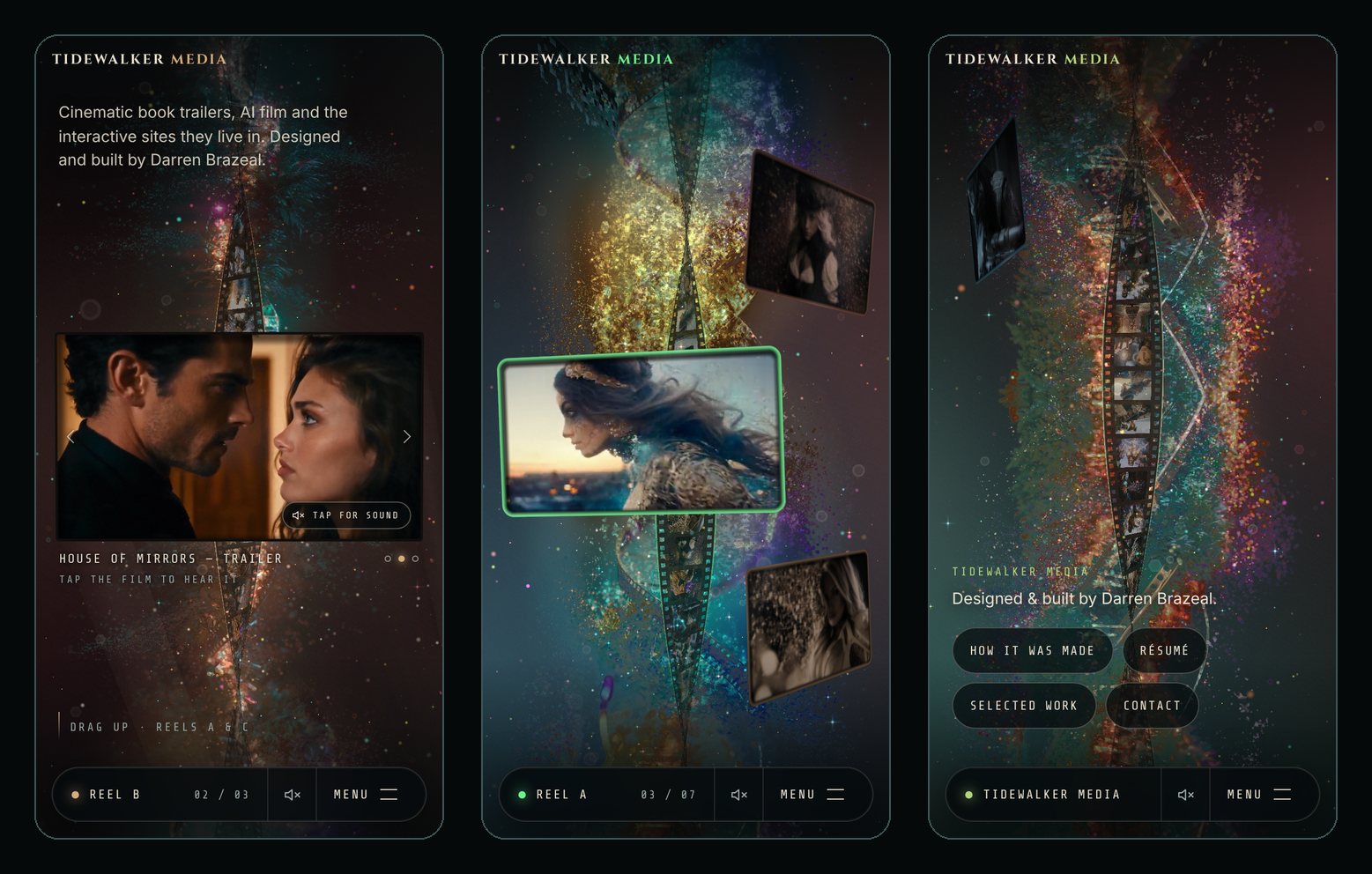
01
A projection room, then the reels
It opens in a projection room with one large screen. The Tidewalker logo plays first, then the House of Mirrors trailer, then the propaganda broadcast. Swipe the screen or use the arrows to switch between them.
Drag up and the roll takes you past twenty small monitors, VFX 1 on the left and VFX 2 on the right. Each one turns to face you as it arrives. Tap one to make it a little bigger.
02
One video for twenty screens
A phone can only play a few videos at the same time. So the twenty monitor clips are combined into one video, laid out like a grid, and each monitor shows its own square of it. The phone plays a single video no matter how many monitors are on screen. The trailer is fully downloaded before it starts, so it does not pause to buffer.
03
The helix and the light
Behind the roll are double helixes. I generated them as still images and art-directed them. They do not repeat on their own, so each one is followed by its mirror image, which makes the joins line up. The sparks twinkle in place, and the background light picks up the color of whichever clip is in front.
04
Steady, quiet, and it has a backup
Nothing sways or drifts by itself. The only movement comes from your thumb, because scenes that float around can make some people dizzy.
The page starts silent, because phones do not allow sound before you tap. One tap brings in the music. Tap the film to hear it, and the music stops for it. If a phone cannot run the 3D scene, it gets the lighter version instead of a blank page. More than forty automated checks cover the phone version before every release.
Also designed and built

An author's world, made interactive.
harpersutton.com is an immersive site for fantasy author Harper Sutton: one continuous animated world, built with TypeScript, Vite and GSAP. It was designed to run on anything, and works as well on a phone as on a desktop.
Visit harpersutton.com